Part 2: Decoding Faces
Diagnoses in Chinese medicine focus more on energy and muscle tone; the term energetic diagnosis is used.
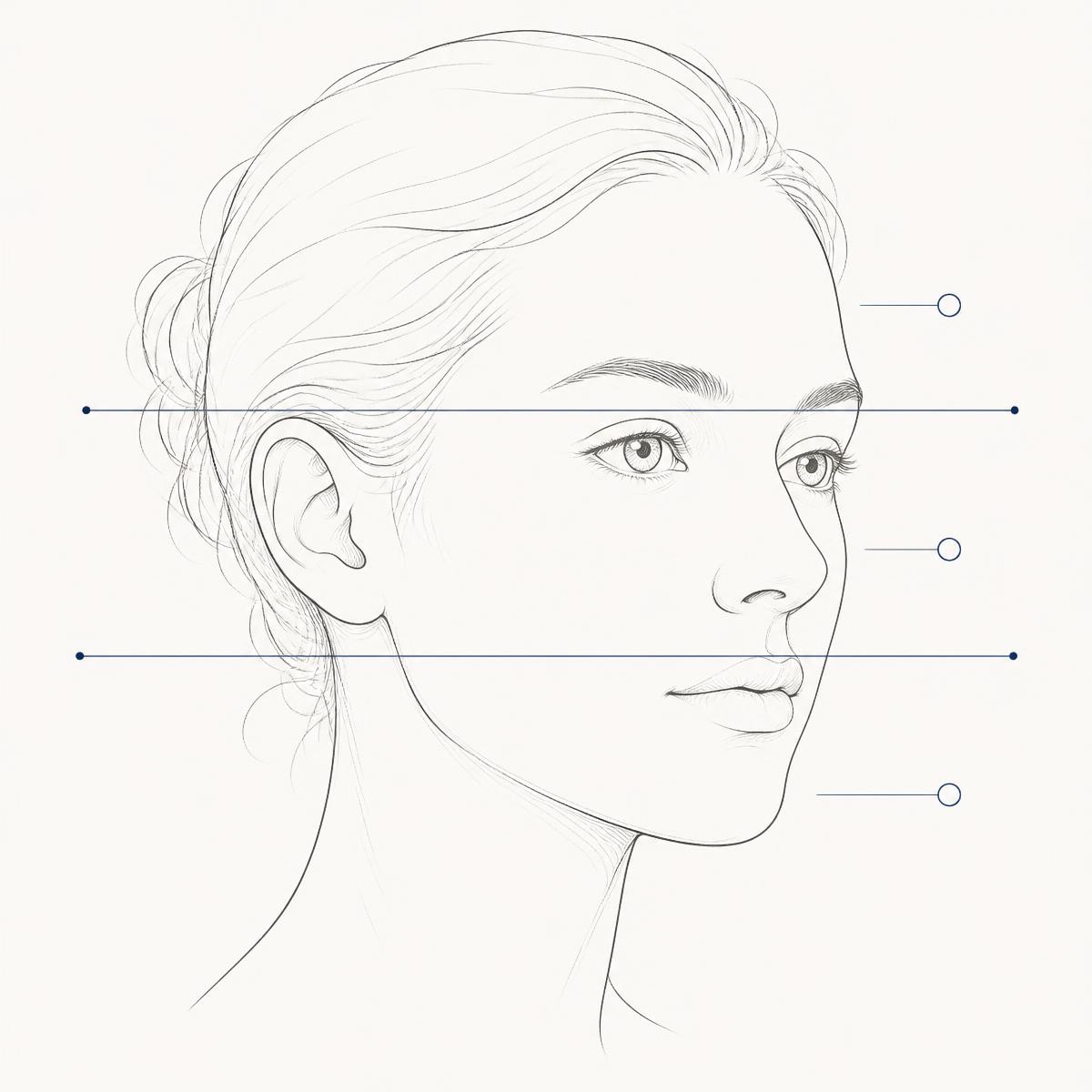
Morphopsychology (particularly in certain schools in France, such as those in Lyon), for its part, offers a reading of the face in three zones:
upper = spirituality
middle = social
lower = earthly / material
Source: AI creation
An analogy can be drawn with the spinal column as a representation of someone's character. At the base of the back, the sphere of dignity is anchored, and the farther one moves upward, the more the sphere of spirituality emerges.
For example, when someone's basic personality is attacked at work, resistance will develop, and it is often located in the lower back, or even in the sciatic nerve.
A collective has even devoted itself to studying the psychology of each vertebra.
In general, tense postures are adopted at work, particularly in the shoulders in jobs involving, for example, computer use. If, during periods of rest at home, work occupies a significant share of one's thoughts, or even becomes an obsession, then pain in the cervical spine will take root. Here, the field of psychosomatics is brought to light.
To continue with the study of the body, a link can be established with a knee disorder, explained by whether or not one bends in spiritual matters.
“The body speaks—let us listen to it!”
“The mind is the origin of the body; disturbances in the mind make the body ill.”
To return to the face:
-studying eyelids whose opening reveals little of the eyes yields an interpretation of discretion; a wide-open eye represents an open soul;
-the eyes provide the most information in deciphering, and thus in bringing character traits to light. The first observation one can make when looking at a face is often based on the gaze. The iris is an infinitely rich source that guides the characterization of the totem.
Do we not say that the eyes are the reflection of the soul?
The iris is therefore the complete image of the soul, of consciousness, and can hide nothing.
Observing the iris allows one to decipher character traits that can be linked to the three categories: animal, plant or mineral.
For an animal-type personality, the entire iris seems to be a single vector that emerges from the pupil and enters the pupil of the person they are speaking to or of the observer. A parallel can be drawn with the irises of dogs or cats that have this type of character, and their behavior can be decoded in their gaze, which follows the gaze of others without blinking. This is ancestral behavior on whose analysis survival depended;
-a uniform iris gives the person a “uniform” character;
-a bright iris implies mobility in the person;
-a rapid movement of the eyes from right to left conveys the expression of inner agitation;